
Academic simulations provide the vocabulary of international relations, but they rarely offer the keys to the room where decisions are made. You've likely felt the frustration of academic exercises that end when the lights go out, leaving you with a sense of potential but no path to professional impact. It's a common barrier for ambitious leaders who are ready to move beyond the hypothetical. A professional diplomacy summit serves as the definitive bridge between theoretical study and institutional reality. It replaces the safety of the classroom with the gravity of global governance.
This article demonstrates how these summits facilitate the transition from student to professional diplomat. You'll discover how to access elite networks, contribute to substantive policy discussions, and build the institutional credibility required for a career of significance. We will analyze the shift from simulation to practice, the role of regional hubs in Brussels and Singapore, and the frameworks that turn engagement into influence. The path to global leadership is no longer a matter of theory. It is a matter of presence.
Key Takeaways
- Institutional rigor. Understand the distinction between academic simulations and a professional diplomacy summit to ensure your engagement drives real-world policy.
- Strategic networks. Cultivate a global circle of diplomatic stakeholders, institutional partners, and policy experts through structured engagement.
- Professional credibility. Transition from role-playing to representing substantive policy positions that resonate within the corridors of international governance.
- Global reach. Identify career-defining opportunities within the 2026 regional hubs located in Brussels, Dubai, Singapore, and New Delhi.
What is a Professional Diplomacy Summit?
A professional diplomacy summit is not a rehearsal. It is a rigorous, institutional forum designed for substantive policy discussion and high-level networking. While traditional educational models often rely on role-playing, these summits demand authentic representation. They bring together delegates, institutional partners, and established stakeholders to address the complexities of modern governance. The environment mirrors the gravity of official international forums; it is a space where professional standards are the baseline and excellence is the expectation.
To understand the evolution of these platforms, one must first ask: What is Diplomacy? In its professional form, it is the art of managing international relations through negotiation and strategic engagement. A professional diplomacy summit operationalizes this definition for a new generation. It moves beyond the classroom. It enters the field of practice. Unlike simulations, these gatherings focus on actionable outcomes. They prioritize professional collaboration over academic competition, ensuring that every contribution has the potential for real-world resonance.
The Core Pillars of Professional Diplomatic Engagement
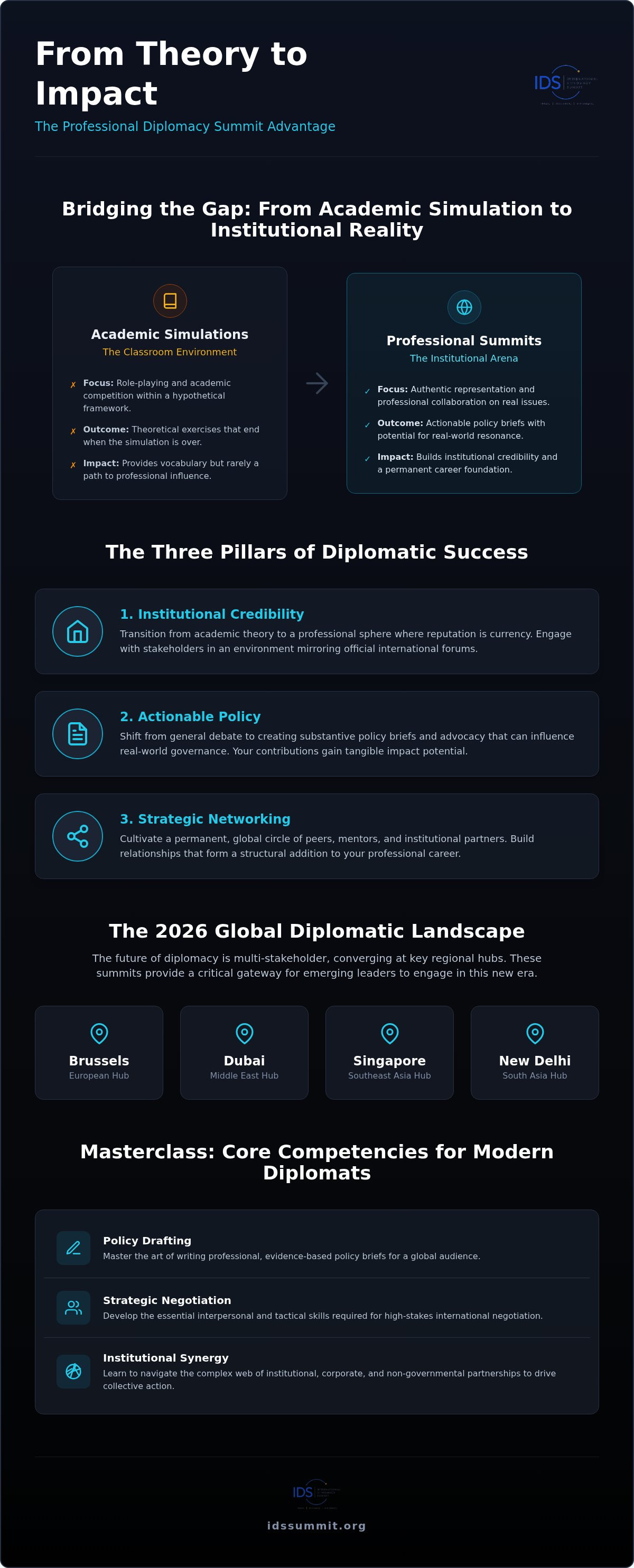
Success in this arena rests on three foundational pillars. First, institutional credibility. Participants step away from academic theory to engage in a professional sphere where reputation is currency. Second, actionable policy. The focus shifts from general debate to the creation of briefs and advocacy that influence real-world governance. Third, strategic networking. The goal is to build a permanent, global network of peers and mentors. These pillars ensure that engagement isn't just a moment in time; it's a structural addition to a leader's career. It's the difference between a temporary exercise and a permanent professional foundation.
Why Professional Forums Matter in 2026
The diplomatic landscape of 2026 requires a shift in perspective. Traditional government channels are no longer the sole arbiters of global policy. We're seeing a move toward multi-stakeholder diplomacy that requires diverse professional inputs from NGOs, educational institutions, and private sectors. Regional hubs in Brussels, Dubai, Singapore, and New Delhi serve as critical points of convergence for this new era. These locations aren't chosen by accident; they represent the pulse of modern international relations.
Emerging leaders need platforms that facilitate engagement outside of rigid state structures. A professional diplomacy summit provides that bridge. It offers a gateway for career-minded individuals to demonstrate their expertise before the world's most influential stakeholders. It's about impact. It's about continuity. It's about the future of international leadership. There's no room for the superficial in this environment. Only the substantial remains.
The Architecture of High-Level Diplomatic Forums
A professional diplomacy summit is defined by its structural integrity. It isn't a collection of casual meetings; it's a deliberate architecture of power and knowledge. Every keynote address, thematic forum, and technical intervention is designed to drive professional growth. This rigor is essential for those transitioning into the professional practice of diplomacy. It ensures that every minute spent in the forum translates into tangible career capital. It is a venue for action. It is a space for growth. It is a pillar for the future.
The environment demands technical precision. Participants don't just speak. They intervene with evidence-based policy briefs. These documents must survive the scrutiny of experts and peers alike. It's a high-stakes setting where your ideas are tested against the realities of global security and sustainable development. This level of engagement requires a commitment to excellence that goes beyond the classroom. If you're ready to test your capabilities, you can apply for delegate participation to join this elite circle and begin building your professional legacy.
Professional Development for Modern Diplomats
The summit operates as a masterclass in professional execution. It focuses on three critical areas of development that are foundational for any international career:
- Policy Drafting: Mastering the art of professional policy brief writing for global audiences.
- Strategic Negotiation: Developing the interpersonal skills required for high-stakes international negotiation.
- Institutional Synergy: Learning to navigate the complexities of institutional and corporate partnerships.
You don't just learn about protocol. You inhabit it. Workshops are led by practitioners who have operated at the highest levels of international governance. They provide the practical frameworks needed to navigate the complexities of the 2026 diplomatic landscape. This ensures that the skills you acquire are not just theoretical but are immediately applicable in professional settings.
The Role of Keynote Addresses and Policy Sessions
Keynote addresses provide more than inspiration. They offer the strategic framework for the entire event. Established leaders from across the globe share insights that mirror real-world diplomatic agendas. This moves the experience from passive listening to active engagement. Participants are expected to synthesize these expert perspectives into their own formal interventions during policy sessions. These forums focus on the most pressing issues, including geopolitics, sustainable development, and global security. By participating in these sessions at a professional diplomacy summit, you align your professional trajectory with the actual needs of the international community. Only the substantial remains.
Beyond Model United Nations: The Professional Advantage
Academic simulations have served their purpose. Model United Nations provides a foundational understanding of procedure, but it remains a controlled environment. A professional diplomacy summit breaks this containment. It demands a higher level of rigor. It requires delegates to transition from role-playing a state's historical stance to representing their own professional policy positions. This isn't about winning a best delegate award. It's about securing a seat at the table of actual influence. The transition is stark. It is necessary. It is definitive.
From Simulation to Professional Diplomacy
The limitations of academic role-play become clear when one enters the professional job market. Employers in international governance prioritize tangible contributions over simulation trophies. While academic competitions reward performance, a professional summit rewards impact. By engaging in diplomatic training and studies, aspiring leaders learn to build a portfolio of substantive policy briefs that resonate with institutional partners. These documents reflect real-world advocacy. They demonstrate intellectual maturity. They provide evidence of a leader's ability to navigate complex geopolitical waters without the safety net of a pre-written script. The focus shifts from the ephemeral to the enduring. It moves from the classroom to the corridor of power.
The Value of Professional Standards and Ethics
Professional gravity is the essential currency of international relations. A professional diplomacy summit enforces formal codes of conduct that mirror those found in the most prestigious global institutions. This institutional distance isn't cold; it's functional. It establishes a level of credibility that academic settings simply cannot replicate. In this environment, you aren't seen as a student exploring a hobby. You are seen as a stakeholder contributing to a shared mission. Adopting these formal standards early in one's career builds a reputation of reliability and serious intent. It signals to global partners that you are ready for high-stakes engagement. Formality breeds respect. Respect builds influence. Influence creates change.
The career ROI of real-world policy advocacy far outweighs academic accolades. When you contribute to a professional forum, you are building visibility with recruiters and institutional leaders. You are moving beyond the sandbox. You are entering the arena. This shift in perspective is what separates a student of international relations from a practitioner of global policy. The architecture of a professional summit ensures that your presence is noted, your voice is heard, and your professional trajectory is accelerated. It's time to leave the simulation behind. It's time to lead.
Strategic Networking: Maximizing the Diplomatic Experience
Engagement at a professional diplomacy summit is a calculated endeavor. It's not about the quantity of contacts but the quality of institutional alignment. Before the first session begins, serious delegates identify key partners and stakeholders who possess the influence to move their policy agendas forward. This preparation turns a casual encounter into a strategic opportunity. It transforms a brief conversation into a professional bridge. It ensures that every interaction is purposeful, methodical, and high-impact.
Your policy brief serves as your primary professional calling card. In this environment, a handshake is secondary to the substance of your ideas. When you present a well-researched intervention, you provide tangible evidence of your value to the diplomatic community. This is how you establish professional social proof. It's how you signal that you're ready for collaborative leadership. To secure your place among these global stakeholders, you can register for the professional diplomacy summit and begin your journey toward institutional influence.
Networking for International Relations Professionals
Success in diplomatic circles relies on the mastery of formal discourse. Engaging with high-level speakers requires a blend of intellectual rigor and professional protocol. You must move beyond the superficial. Focus on identifying shared institutional goals. Use parallel phrasing to mirror the gravity of the setting. By adopting the tone of a peer rather than a spectator, you establish a sense of professional equality. This transition from a casual introduction to a strategic alignment is the hallmark of a true practitioner. It builds trust. It creates continuity. It fosters lasting impact.
The Role of Institutional Summit Partnerships
Institutional partners, including major NGOs and corporate entities, are the silent engines of global policy. They don't just attend; they drive agendas through their participation. Delegates must understand how these organizations operate to maximize their engagement. By aligning your personal policy positions with the missions of these institutional stakeholders, you create a synergy that extends far beyond the summit floor. This is an opportunity for institutional growth and individual career acceleration. Brand visibility at global summits isn't just for the organization; it's for the leaders who represent them. Every partnership is a gateway. Every dialogue is a structure. Every connection is a career-defining moment.
The final step in maximizing the experience is the follow-up. A connection made at the summit only becomes an opportunity if it is nurtured through formal channels. Reference the specific policy discussions you shared. Offer concrete next steps for collaboration. By maintaining the professional standards established during the event, you turn a single meeting into a permanent fixture of your professional network. The summit is the starting line, not the finish.
The Professional Diplomacy Summit Experience
The environment of an IDS event is characterized by institutional rigor and formal excellence. It is not a casual gathering. It is a methodical professional arena. Delegates move beyond the constraints of academic study to engage in the actual mechanics of international relations. The transition is deliberate. It is structured. It is career-defining. By registering for a professional diplomacy summit, participants commit to a higher standard of engagement. They become recognized policy advocates who contribute to the creation of lasting structures. This is where theory meets the field of practice. The focus remains on continuity, action, and global reach. There is no wasted space in these forums; every session serves a purpose, every dialogue builds a career, and every intervention strengthens a professional reputation.
Shaping the Future of Governance
The 2026 summit series represents the definitive venue for those seeking tangible global impact. It is a visionary network dedicated to professional excellence. Here, individual contributions coalesce into a collective force for change. Delegates work toward shared policy goals that address the complexities of modern geopolitics, global security, and sustainable development. This isn't merely an event. It's a foundational step in a lifelong career of service and influence. The path to leadership is open to those ready to accept the responsibility of high-stakes engagement. The 2026 hubs in Brussels and Singapore are specifically designed to facilitate these critical interactions between emerging leaders and established stakeholders.
You must act with precision to secure your future in this elite circle. Secure your place as a Delegate for the 2026 International Diplomacy Summit and join a global community of practitioners. The world's most pressing challenges require a professional response. The 2026 summits provide the platform. Your expertise provides the solution. Only the substantial remains. The future of governance is being written now. Be the one who writes it.
Securing Your Place in the Diplomatic Vanguard
The transition from academic theory to institutional practice is a deliberate choice. It requires a commitment to rigor, a focus on actionable policy, and an understanding of formal diplomatic protocol. By participating in these high-level forums, you move beyond the limitations of role-playing to engage directly with global stakeholders. You aren't just attending an event; you're building a foundation for a career of significance. This is where you establish your credibility, cultivate a visionary network, and contribute to the structures of tomorrow's governance. Attending a professional diplomacy summit is the definitive step for those ready to leave the sandbox of simulation behind.
The 2026 summit series offers an institutional venue for high-level policy advocacy and professional career development on a global scale. It's time to translate your ambition into tangible outcomes. Your presence in these rooms signals a readiness for the highest levels of international service. It's a commitment to excellence that resonates with partners and recruiters alike.
Register as a Delegate for the next Professional Diplomacy Summit and claim your seat at the table where the future is decided. The world is waiting for leaders who don't just study history but actively shape it. Your journey from advocate to architect begins now.
Frequently Asked Questions
What is a professional diplomacy summit?
A professional diplomacy summit is a high-level institutional forum designed for substantive policy discussion and strategic networking among global stakeholders. It replaces academic role-playing with authentic engagement in real-world diplomatic agendas. These summits operate as permanent pillars of international governance. They offer delegates the opportunity to represent personal professional policy positions in major global hubs like Brussels, Dubai, and Singapore.
How does this summit differ from a Model United Nations (MUN) simulation?
The primary distinction lies in the transition from role-playing to reality. MUN simulations focus on academic competition and historical stances; however, a professional summit prioritizes actionable outcomes and authentic representation. You don't represent a country in a scripted exercise. You represent your own professional expertise and policy advocacy. This shift ensures that every intervention has the potential for tangible impact within the international community.
Who should attend a professional diplomacy summit?
This forum is designed for career-minded emerging leaders, international relations practitioners, and visionary stakeholders seeking high-level engagement. It is the ideal venue for those ready to move beyond the classroom. If you value professional credibility and formal standards, this platform offers the necessary institutional gravity. Attendees typically include ambitious professionals aiming to transition into global governance, policy advocacy, or strategic international partnerships.
What are the professional benefits of summit delegate participation?
Summit delegate participation offers three primary advantages: access to elite networks, contribution to substantive policy, and enhanced institutional credibility. You build a permanent portfolio of policy contributions that resonate with global employers. This engagement facilitates a direct transition from theory to professional practice. It provides the visibility required to accelerate an international career within the 2026 diplomatic landscape.
How do I prepare a policy brief for a professional summit?
Preparation for a professional diplomacy summit requires technical rigor and evidence-based analysis. Your brief should address contemporary global challenges with precise, formal language. It serves as a professional calling card during sessions. Focus on creating actionable recommendations that mirror real-world diplomatic agendas. This document must survive expert scrutiny and establish your reputation as a serious stakeholder in the international arena.
Are there institutional partnership opportunities available?
Yes, the International Diplomacy Summit offers structured partnership opportunities for NGOs, corporate entities, and educational institutions. These partnerships drive global policy agendas and enhance brand visibility at the summit. Organizations can align with the summit’s mission to foster professional excellence and institutional synergy. This collaboration ensures that your organization remains a permanent fixture in the strategic world of international relations.
What is the dress code and conduct expected at a professional summit?
Participants must adhere to a strict code of professional conduct and formal attire. The environment mirrors the gravity of official international governance forums; therefore, business formal dress is mandatory for all sessions. Conduct is governed by established diplomatic protocol and formal standards of discourse. This institutional distance ensures a level of prestige and reliability that is essential for high-stakes global engagement.
Will I receive professional certification after the summit?
Every delegate receives a formal certification of participation and policy advocacy upon the conclusion of the summit. This document serves as a testament to your professional engagement and institutional credibility. It is a recognized asset for those building careers in international governance or global leadership. The certification reflects your commitment to professional excellence and your ability to operate within a high-stakes, rigorous environment.

