
Academic simulations are no longer sufficient for those who intend to lead the global order. You understand the weight of theory, the complexity of history, and the structure of governance. Yet, you likely feel the persistent gap between classroom debate and the rooms where decisions are actually made. It's a common frustration for the ambitious. You've mastered the literature, but the path to tangible policy impact remains obscured. Understanding the strategic benefits of attending international relations conferences is the first step toward bridging this divide and moving from student simulations to real policy influence.
These professional diplomacy summits serve as institutional gateways. They transform academic rigor into practical execution for the next generation of global leaders. By engaging in high-level forums in hubs like Brussels or Singapore, you move past the hypothetical. You enter a space defined by action, continuity, and reach. This article explores how these summits facilitate professional-grade networking, provide a platform for real policy contributions, and secure your position within the global diplomatic landscape. We'll examine the specific frameworks that turn a delegate’s presence into a permanent career advantage.
Key Takeaways
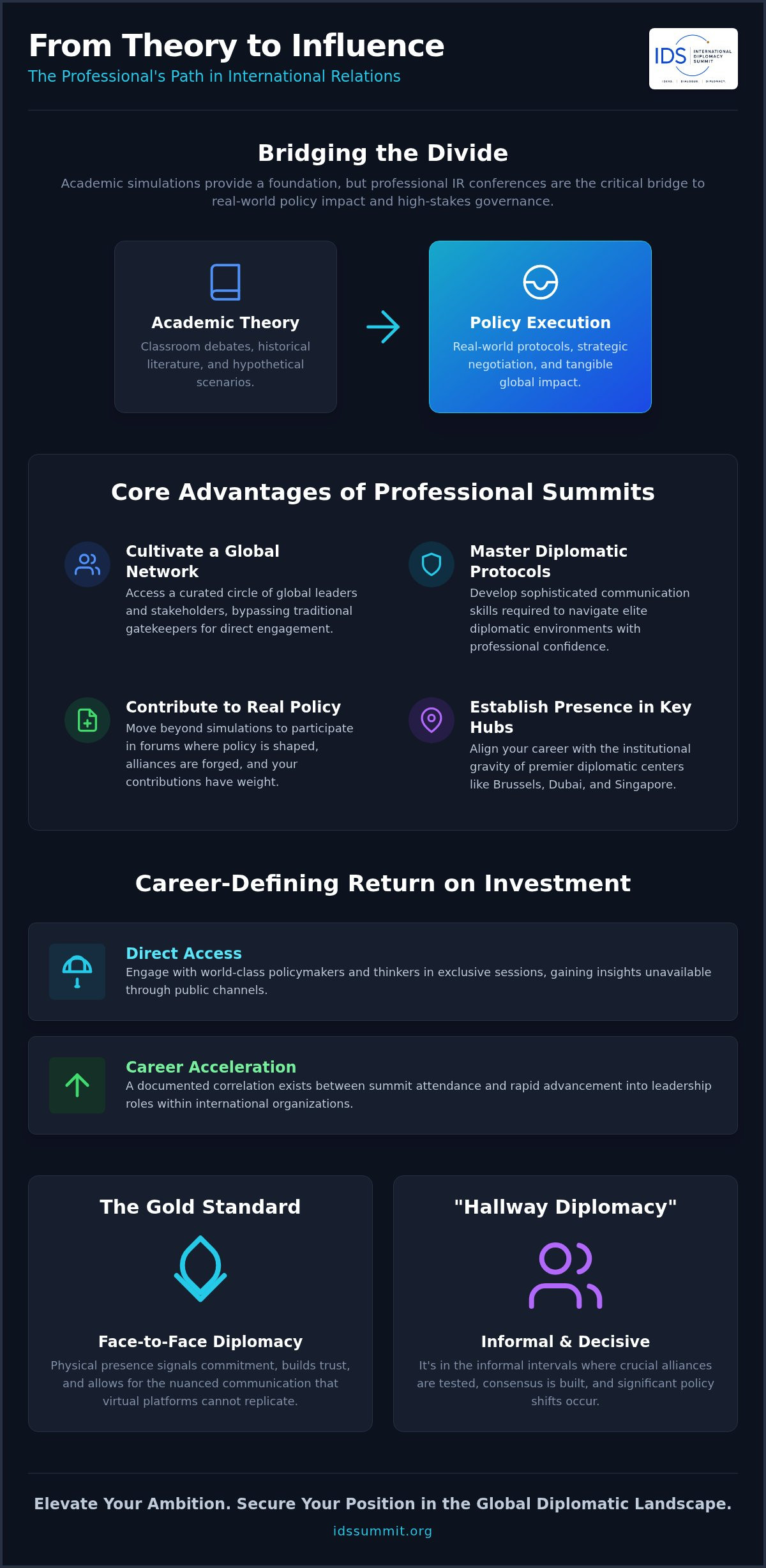
- Bridge the divide between academic theory and professional execution. Learn to transition from the realm of role-play to high-stakes governance and real-world policy advocacy.
- Cultivate a curated network of global leaders. Leverage the strategic benefits of attending international relations conferences to access the informal "hallway diplomacy" where significant policy shifts occur.
- Master the rigorous protocols of international engagement. Develop the sophisticated communication skills and stakeholder research required to navigate elite diplomatic environments with professional confidence.
- Position your career within the world’s premier diplomatic hubs. Align your professional development with the institutional gravity of summits in Brussels, Dubai, and Singapore.
The Professional Imperative: Why IR Conferences Matter in 2026
The global order is recalibrating. In 2026, the strategic landscape demands more than digital proximity; it requires physical presence, institutional weight, and decisive engagement. Professional international relations conferences have evolved into essential venues for high-stakes governance. They're no longer merely academic gatherings. They're strategic forums where policy is shaped, alliances are forged, and professional credibility is established. One of the primary benefits of attending international relations conferences in this climate is the opportunity to secure a seat within these permanent structures of power.
Digital networking platforms offer convenience. They do not offer gravity. The physical presence of a delegate at a summit signals a commitment to the long-term stability of international systems. It projects a sense of duty and ambition that a virtual screen cannot replicate. In an era defined by strategic ambiguity and shifting power blocs, face-to-face diplomacy remains the gold standard for high-level professional engagement. It's about presence. It's about influence. It's about impact.
Bridging the Gap: Theory vs. Practical Diplomacy
Within the academic discipline of international relations, theory provides the necessary foundation for understanding global dynamics. However, the application of that theory requires a transition to the practical realm. At a professional summit, you move beyond the textbook to observe real-world diplomatic protocol in action. You learn to interpret the nuances of non-verbal communication, the timing of a formal intervention, and the subtle art of consensus-building. Professional diplomacy is the execution of strategic interests through formal engagement and structured negotiation.
The ROI of Delegate Participation
Investing in delegate participation is a career-defining decision. The return on investment is measured through exclusive access, professional placement, and institutional growth. Consider the following advantages:
- Direct Access: Engaging with world-class thinkers and policy makers during exclusive keynote addresses provides insights that aren't available in public reports.
- Career Acceleration: There's a documented correlation between summit attendance and rapid advancement into leadership roles within international organizations.
- Institutional Continuity: For organizations, forming summit partnerships ensures a permanent presence in global hubs like Brussels, Dubai, and Singapore.
These forums act as a foundational pillar for those seeking to make a significant impact. They provide the professional efficiency and strategic framework necessary to navigate the complex world of 2026 geopolitics. By moving from theory to practice, you establish yourself as a serious fixture in the field.
Strategic Networking: Building a Global Diplomatic Circle
Networking within the upper echelons of global governance is a deliberate, strategic act. It requires more than a casual exchange of contact information; it demands alignment with institutional goals. One of the primary benefits of attending international relations conferences is the immediate access to a curated network of diplomatic stakeholders who are otherwise shielded by layers of administrative gatekeepers. In these elite forums, delegate status provides an implicit level of professional credibility. You aren't merely an observer. You're a participant in a high-stakes environment where the future of policy is actively debated.
The concept of "hallway diplomacy" remains a cornerstone of professional success. While formal sessions provide the necessary structure, the informal intervals often host the most significant policy discussions. These are the moments where alliances are tested and new frameworks are proposed. Navigating these spaces requires a sophisticated understanding of protocol and a clear sense of professional purpose. By engaging in these dialogues, you establish yourself as a serious fixture in the diplomatic circle. You move from the periphery of international affairs to the very center of professional action.
Structured Professional Engagement
Participation in exclusive networking forums and roundtable discussions offers a platform for institutional visibility. It isn't enough to simply attend; you must contribute with precision and authority. A successful summit experience is defined by the rigor of your follow-up strategy. Professionals don't rely on chance encounters. They utilize summit platforms to initiate formal dialogues that extend far beyond the closing ceremony. For those seeking to elevate their professional standing, exploring Summit Delegate Participation offers a clear pathway to this level of engagement.
Mentorship and Peer Collaboration
The senior diplomatic corps serves as a repository of institutional wisdom. Accessing this knowledge through direct mentorship is a distinct advantage of the professional summit format. These leaders are often looking to identify and guide the next generation of global influencers. Simultaneously, the peers you meet today are the ambassadors and policy makers of tomorrow. Initiating joint projects across borders establishes a foundation for lifelong professional collaboration. Understanding the benefits of attending international relations conferences allows you to leverage these forums for tangible career growth. In this context, the International Diplomacy Summit acts as a definitive mentor. It provides the structure, the network, and the authoritative platform needed to transition into high-level leadership roles.
Beyond Simulations: The Value of Real-World Policy Forums
Academic simulations like Model United Nations (MUN) serve a foundational purpose. They introduce the mechanics of debate. They build initial confidence. They foster an interest in global affairs. However, these simulations remain bounded by the hypothetical. For the professional seeking a career in global governance, there's a definitive need to move beyond role-play. The International Diplomacy Summit (IDS) 2026 represents this necessary shift. It's a venue where the stakes are real, the participants are established professionals, and the outcomes carry institutional weight. Recognizing the benefits of attending international relations conferences involves understanding this transition from simulation to execution.
Role-playing is a pedagogical tool. Professional advocacy is a career mandate. When you step onto the floor of a professional summit, you aren't representing a fictionalized version of a state's interests. You're engaging with the actual strategic priorities of your organization or institution. This shift in perspective is transformative. It requires a higher register of communication, a deeper level of stakeholder research, and a commitment to tangible results. You're no longer practicing for the future. You're participating in it.
Real-World Policy Advocacy
Professional summits focus on current geopolitical friction points. In 2026, these discussions center on the rising influence of BRICS states, the complexities of digital diplomacy, and the management of strategic ambiguity. Engaging with these challenges requires more than just academic knowledge; it requires the ability to produce professional policy briefs that can withstand the scrutiny of diplomatic stakeholders. These documents aren't graded for credit. They're evaluated for their strategic utility and their potential to influence real-world outcomes. Professional summits turn theoretical knowledge into tangible impact by placing delegates in direct contact with current geopolitical friction points.
Establishing Professional Authority
Delegate status at an elite forum signals a serious commitment to the field. It's a badge of professional credibility that academic simulations cannot provide. By building a portfolio of participation in summits held in hubs like Brussels, Singapore, or Dubai, you establish a track record of engagement with high-level governance. This is how leaders are identified. This is how careers are accelerated. Moving beyond the academic simulation phase is essential for anyone who intends to be more than a spectator in the international arena. Validating your expertise through professional delegate certification ensures that your contributions are recognized within the formal channels of international relations. It transforms your ambition into a documented history of professional achievement.
Mastering the Summit: How to Engage as a Professional Delegate
Mastering the environment of a high-stakes summit requires more than passive attendance. It demands a rigorous methodology. Preparation. Engagement. Continuity. These are the three pillars of professional success in global governance. To fully realize the benefits of attending international relations conferences, a delegate must arrive with a defined strategic agenda. Before the first formal session begins in hubs like Brussels or Singapore, you must analyze the stakeholder landscape, identify key policy friction points, and refine your institutional objectives. You aren't there merely to listen. You're there to influence the trajectory of global discourse.
Professional engagement is a deliberate act. It requires a transition from the role of an observer to that of an active contributor. This transition is marked by the precision of your interventions and the weight of your professional presence. In 2026, where geopolitical shifts are rapid and complex, your ability to navigate these forums with authority determines your career trajectory. It's about establishing a permanent, serious fixture for yourself within the diplomatic community. It's about moving from theory to tangible impact.
The Policy Brief Strategy
The 2026 Foreign Policy Summit focuses on the recalibration of global alliances and the rise of digital diplomacy. Success depends on your ability to synthesize these themes into a concise, actionable policy brief. This document serves as your primary tool for institutional visibility. Pitching a brief to a senior diplomatic stakeholder requires precision, timing, and a clear alignment with strategic interests. Utilizing the International Diplomacy Summit (IDS) platform allows you to move your ideas from the periphery to the center of global discussion. It's about making your expertise visible and your contributions indispensable to the mission at hand.
Professional Conduct and Protocol
Navigating formal diplomatic sessions requires mastery of established protocols. This isn't about mere etiquette; it's about professional gravity. Every interaction, from the high-level introduction to the formal intervention, must reflect your institutional standing. You must represent yourself with a sense of duty and visionary confidence. Consider these core elements of professional conduct:
- Precision in Communication: Use high-register language that denotes action, continuity, and global reach.
- Strategic Introductions: Make every encounter count by clearly stating your professional purpose and institutional value.
- Formal Interventions: Contribute to roundtable discussions with authority, intellectual weight, and a focus on practical solutions.
Maintaining momentum after the closing ceremony is equally critical. Professional partnerships are sustained through methodical follow-up and the creation of lasting structures. To begin this journey and secure your place among the world's leading policy makers, you should register for Summit Delegate Participation today. This is more than a meeting; it's a foundational pillar for your professional future.
Elevating Your Ambition at the International Diplomacy Summit
The International Diplomacy Summit (IDS) 2026 stands as a permanent, serious fixture in the landscape of global governance. It's not merely an event. It's a foundational pillar for those who refuse to be spectators in the shaping of the global order. For the ambitious professional, the benefits of attending international relations conferences are fully realized when the platform matches the scale of their vision. IDS 2026 provides that platform. It offers a sophisticated environment where visionary confidence meets institutional rigor. Here, the transition from academic theory to real-world policy impact is not just encouraged; it's executed.
Institutional stability requires a commitment to lasting structures. Organizations that choose summit partnerships do so to secure their strategic reach and establish a permanent presence in the rooms where decisions are made. These partnerships aren't temporary arrangements. They're career-defining investments in the continuity of international leadership. By aligning with IDS, both individual delegates and institutions signal their readiness to lead with authority and professional gravity. You move beyond the ephemeral and enter a space of enduring significance.
The 2026 Global Program
The 2026 summit series is strategically decentralized across four major diplomatic hubs. Brussels. Dubai. Singapore. New Delhi. Each location serves as a distinct thematic theater for high-level engagement. The program focuses on the most pressing challenges of the decade: the recalibration of great-power alliances, the evolution of digital diplomacy, and the management of strategic ambiguity. This geographic and intellectual breadth ensures that every participant engages with the specific geopolitical friction points relevant to their professional focus. To secure your position within this prestigious framework, you can Register as a delegate for the next IDS summit. The 2026 schedule is designed for maximum professional efficiency and strategic impact.
Your Path to Global Impact
IDS facilitates a deliberate progression from simulation to real-world diplomacy. The network you build here is not a casual collection of contacts; it's an elite circle of global diplomatic professionals. These are the peers and mentors who will define the next thirty years of international policy. The long-term benefits of the IDS network include sustained institutional visibility and access to exclusive policy forums that remain closed to the general public. It's a gateway to a higher level of professional engagement. It's time to move past the role-play of the classroom and embrace the weight of professional duty. Join the elite circle. Execute your strategy. Lead the global order.
Securing Your Position in the Global Order
The trajectory of a global career is defined by the quality of its foundations. You've moved beyond the realm of academic theory. You've recognized the necessity of professional engagement. By embracing the strategic benefits of attending international relations conferences, you transition from an observer to a decisive participant in the global order. These forums provide the institutional gravity required to bypass traditional gatekeepers. They offer a professional platform for young leaders to execute real-world policy impact across major diplomatic hubs like Brussels, Dubai, and Singapore.
The International Diplomacy Summit series represents a permanent commitment to professional excellence. It's a gateway to high-stakes governance. It's a catalyst for tangible career advancement. Don't remain on the periphery of international affairs. Secure your delegate pass for the 2026 International Diplomacy Summit and establish your institutional presence today. Your ambition deserves a professional structure of this scale. The world is recalibrating; ensure your voice is part of the new consensus.
Frequently Asked Questions
Is an international relations conference worth it for early-career professionals?
Yes. Participation in these forums accelerates your career trajectory by bypassing traditional professional gatekeepers. One of the primary benefits of attending international relations conferences is the immediate transition from academic theory to practical execution. Early-career leaders establish their credibility in global hubs like Brussels or Singapore, moving from the periphery of international affairs to the center of professional action.
What is the difference between an academic conference and a professional diplomacy summit?
Academic conferences focus on research dissemination and theoretical debate. Professional diplomacy summits focus on high-stakes governance and real-world policy impact. While academia explores the "why" of international relations, summits execute the "how" of strategic interests. The International Diplomacy Summit 2026 provides a platform for action, continuity, and reach within the formal channels of global leadership.
How do I prepare a policy brief for an international summit?
Focus on current geopolitical friction points and institutional objectives. Identify a specific challenge, analyze the interests of diplomatic stakeholders, and propose a practical framework for action. A professional brief must be concise, authoritative, and strategically aligned. It serves as your primary tool for gaining visibility and influencing the trajectory of high-level roundtable discussions.
Can I attend the International Diplomacy Summit if I am still a student?
Yes. Aspiring global leaders are encouraged to participate as delegates. The summit serves as a gateway for students to move beyond simulations and enter the realm of professional engagement. It provides a foundational pillar for those seeking to build a peer network of future ambassadors and policy makers while still completing their studies.
What are the networking opportunities available for summit delegates?
Delegates gain access to curated networking forums and exclusive roundtable discussions. Opportunities include high-level introductions, formal interventions, and the critical "hallway diplomacy" where significant policy shifts often begin. This structured environment allows for direct engagement with senior diplomatic stakeholders in major hubs such as Dubai and Singapore.
How does delegate registration help with my career in international relations?
Registration secures your position within an elite professional circle and signals a serious commitment to the field. It builds a documented history of engagement with high-level governance. Many professionals find that the benefits of attending international relations conferences include rapid placement in leadership roles and the creation of lasting professional structures.
Will I receive professional certification for attending the IDS 2026 summit?
Yes. All delegates receive professional certification that validates their expertise in diplomatic protocol and policy advocacy. This credential serves as a permanent record of your participation in high-stakes governance. It reinforces your professional credibility and positions you as an authoritative expert in the world of international relations.
How do institutional partnerships work at the International Diplomacy Summit?
Partnerships allow organizations to establish a permanent, serious presence in global diplomatic hubs. Institutions gain institutional visibility, influence key policy themes, and foster long-term continuity within the diplomatic corps. This structure supports the creation of lasting global frameworks rather than temporary or casual projects.

