
Academic excellence is no longer the primary currency of international influence. In the high-stakes corridors of 2026, the ability to bridge the gap between classroom theory and institutional gravity defines the modern leader. You've likely mastered the textbooks, yet the transition to real-world multi-lateral environments requires a specific set of diplomatic negotiation skills that academic simulations simply cannot replicate. It's a common frustration to possess the intellectual weight but lack the professional arena to apply it. You deserve more than a rehearsal; you require a platform for substantive impact.
This guide provides the definitive framework to move beyond the limitations of theory and into the realm of professional tradecraft. We'll show you how to engage in high-stakes environments with precision, confidence, and authority. You'll gain a clear understanding of "behind the table" dynamics, access to professional-grade networking, and the structural knowledge required for global engagement. It's time to stop studying the world and start shaping it. Let's explore the rigorous path to becoming a foundational pillar in the world of international governance.
Key Takeaways
- Transition from transactional deals to enduring consensus by internalizing diplomatic negotiation skills as a continuous, relationship-centric tradecraft.
- Master the art of cognitive empathy to accurately map a counterpart’s internal institutional constraints and strategic vulnerabilities.
- Cultivate a "Team of Rivals" structure to ensure that internal friction translates into external resilience and comprehensive policy advocacy.
- Integrate modern digital diplomacy tools, including AI-assisted sentiment mapping, to refine your strategic approach beyond traditional frameworks.
- Bridge the gap between theory and practice through Summit Delegate Participation in high-stakes global forums across Brussels, Dubai, and Singapore.
Beyond Academic Theory: The Professionalization of Diplomatic Negotiation Skills
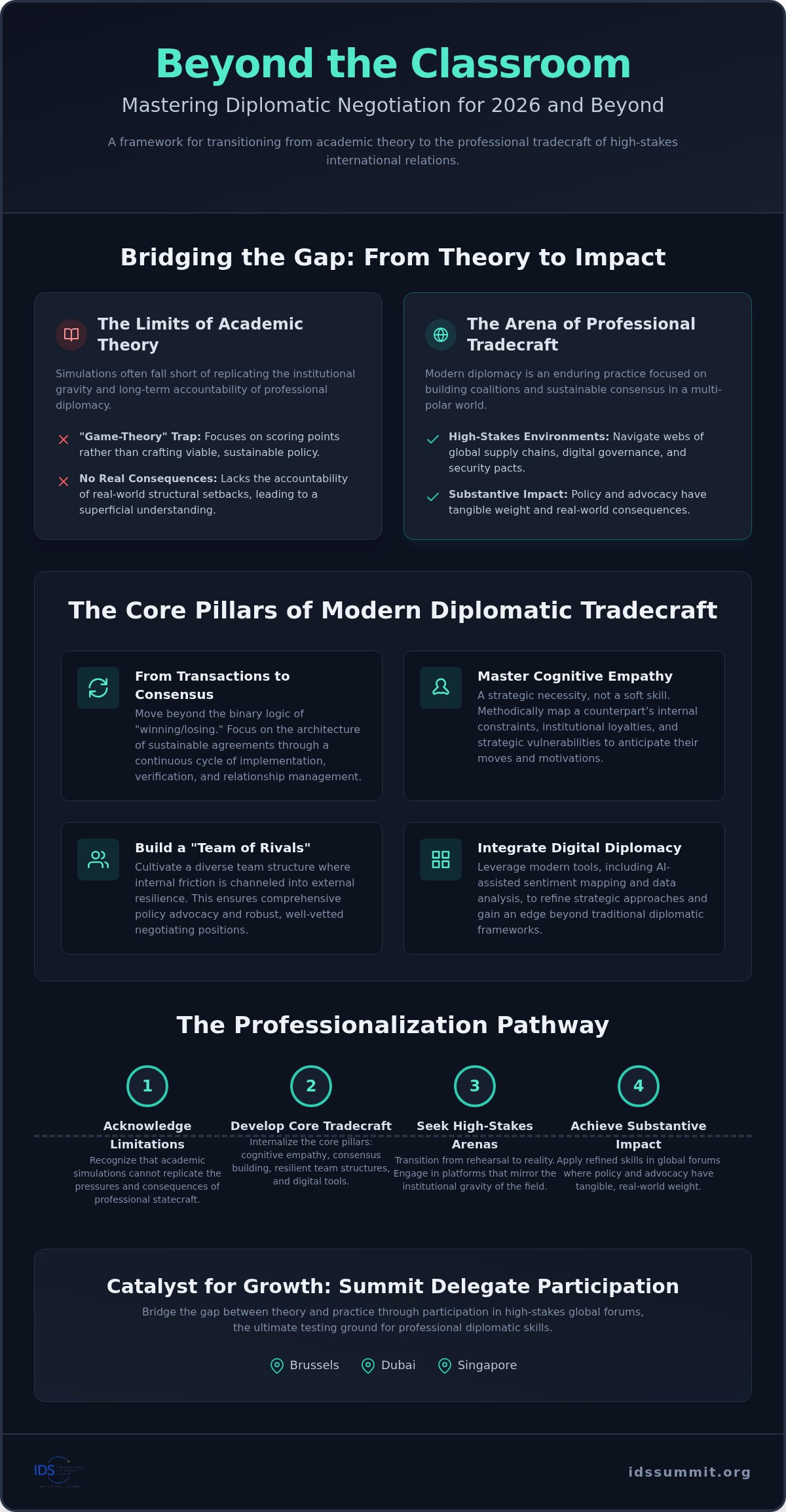
Diplomatic negotiation is not a transactional event. It is an enduring tradecraft. In the professional arena, a negotiation doesn't end with a signature; it begins a cycle of implementation, verification, and relationship management. True diplomatic negotiation skills require a departure from the binary logic of "winning" or "losing." Instead, the modern practitioner focuses on the architecture of sustainable consensus. This shift represents the professionalization of the field, moving away from isolated deals toward the creation of lasting international structures.
The 2026 geopolitical landscape demands this evolution. The history of diplomacy shows a steady progression from bilateral statecraft to the complex, multi-lateral frameworks we navigate today. In this environment, professional development for diplomats is a lifelong career pillar. It is the rigorous process of refining one's ability to manage high-stakes friction while maintaining institutional gravity. This isn't merely about communication; it's about the strategic application of intellectual weight and formal authority.
The High-Stakes Environment of 2026 Geopolitics
Modern diplomacy operates within a multi-polar reality. Power is no longer concentrated; it is distributed across traditional states, non-state actors, and massive institutional partnerships. This fragmentation requires a new level of systemic thinking. Professional development for diplomats must now include the ability to map these overlapping interests. You aren't just negotiating with a counterpart. You're navigating a web of global supply chains, digital governance standards, and regional security pacts. Success in 2026 is defined by your capacity to build coalitions that survive the initial headlines.
Why Simulations Fall Short of Professional Tradecraft
Academic simulations often fall into a "game-theory" trap. Participants frequently prioritize scoring points over crafting viable policy. These environments lack the one element that defines professional diplomacy: accountability. In a simulation, a failed negotiation is a learning moment; in the professional world, it is a structural setback with real-world consequences. This absence of long-term responsibility creates a superficial understanding of the tradecraft.
To bridge this gap, aspiring leaders must seek out platforms that mirror the institutional gravity of the field. Engaging in the international diplomacy summit allows for a transition from rehearsal to reality. These forums provide the necessary friction of high-level engagement, where policy briefs and advocacy have tangible weight. By moving beyond the student-led environment, you enter a space where diplomatic negotiation skills are tested against professional standards, ensuring your development is grounded in the methodical and strategic world of international relations.
Core Pillars of Diplomatic Tradecraft: Mastering Cognitive Empathy
Professional diplomacy requires more than rhetoric. It demands a rigorous psychological framework. Mastering diplomatic negotiation skills in 2026 centers on the precision of cognitive empathy. This is not a soft skill. It is a strategic necessity. It involves the methodical mapping of a counterpart’s internal constraints, institutional loyalties, and domestic pressures. To lead is to understand the invisible forces acting upon those across the table.
Successful tradecraft relies on the ability to translate national interests into shared global values. This cross-cultural framing ensures that your objectives appear as solutions for the collective. During high-pressure plenary sessions, the art of active listening becomes paramount. You aren't just waiting for your turn to speak. You're analyzing shifts in tone, identifying hesitant support, and detecting the subtle realignment of coalitions. This level of engagement transforms a standard meeting into a strategic opportunity.
The "Shoes of the Counterpart" Method
Effective negotiation begins long before the first statement. You must conduct an exhaustive audit of your counterpart’s environment. Follow these steps to build a comprehensive profile:
- Analyze domestic political pressures, such as upcoming election cycles or economic instability.
- Identify institutional red lines that the negotiator cannot cross without losing credibility at home.
- Evaluate the counterpart’s personal history and previous negotiation patterns in multi-lateral settings.
Cognitive empathy is the foundational skill of the 2026 diplomat. By anticipating a counterpart's limitations, you can offer solutions that they are politically capable of accepting. This foresight prevents the embarrassment of public rejection and maintains the dignity of the forum.
Strategic Patience and Concession Management
Patience is a weapon. In multi-lateral forums, the "concession cycle" dictates the pace of progress. The first concession is often the most dangerous move. It signals vulnerability rather than flexibility, potentially emboldening aggressive counterparts. Instead, maintain momentum through technical clarifications and procedural adjustments that don't compromise core policy. Aspiring leaders can refine these high-stakes maneuvers through Summit Delegate Participation, where the theory of tradecraft meets the reality of the plenary floor.
When negotiations reach an impasse, the elite negotiator utilizes informal sessions. These "corridor diplomacy" moments allow you to test concessions without public commitment. They provide a safe space to explore "what-if" scenarios. By the time the parties return to the formal table, the path to a sustainable consensus has already been paved through discreet, strategic dialogue. This methodical approach ensures that every movement is deliberate, every pause is purposeful, and every agreement is durable.
Structural Negotiation: Building and Leading Diverse Diplomatic Teams
Negotiation is rarely a solitary endeavor. It is a collective performance. Professional diplomatic negotiation skills involve the ability to build, lead, and synchronize a diverse delegation. While academic exercises often focus on the individual speaker, the reality of 2026 diplomacy is found in structural coordination. A leader’s success depends on the integrity of their team. You aren't just a voice; you're the conductor of a complex institutional orchestra.
Defining key roles is the first step toward institutional stability. The Lead Negotiator provides the vision, the voice, and the institutional authority. The Technical Expert ensures every claim is backed by verifiable data and policy rigor. The Silent Observer monitors the psychological landscape of the room. This trinity creates a balance of authority, precision, and awareness that no individual can achieve alone. It ensures the delegation remains focused, disciplined, and resilient.
Managing "behind the table" dynamics is as critical as the dialogue across it. If your own delegation lacks alignment, your position will crumble under the first sign of pressure. Developing diplomatic networking skills allows you to manage not just your team, but the broader coalition of partners required for a successful outcome. You're building a network of support that extends beyond the immediate session and into the long-term implementation phase.
Diversity Over Affinity in Team Composition
Effective teams are built on cognitive diversity and regional expertise. You shouldn't seek affinity; you must seek friction. By selecting members with dissenting views, you ensure that every policy position is stress-tested before it reaches the plenary floor. Developing these diplomatic negotiation skills within a team context requires implementing a "Red Team" to act as an internal adversary. Their job is to find the cracks in your strategy. By managing these internal rivalries, you ensure the team presents a unified, impenetrable front to your counterparts.
The Silent Observer: A Tactical Asset
The Silent Observer is your most undervalued tactical asset. While the Lead Negotiator speaks, the Observer analyzes. They track non-verbal cues, hesitant support, and subtle shifts in the room’s energy. They feed real-time data to the lead, allowing for immediate tactical shifts. Implementing feedback loops during scheduled breaks ensures your strategy remains agile. This methodical approach ensures that your delegation isn't just reacting to the room, but actively shaping its momentum through deliberate, data-driven adjustments.
Essential Professional Development Resources for Diplomats
Developing elite diplomatic negotiation skills requires a commitment to continuous professional refinement. In the multi-polar era of 2026, relying on 20th-century paradigms is insufficient. You must integrate modern frameworks, digital toolkits, and high-level platforms to maintain institutional relevance. This transition from theory to practice is a deliberate process. It requires the right tools. It demands the right environment. It necessitates a focus on enduring impact.
Principled Negotiation and BATNA 2.0
The classic "Getting to Yes" framework remains a cornerstone, yet it requires a 2026 update. In a non-linear world, calculating your Best Alternative to a Negotiated Agreement (BATNA) is no longer a static exercise. It's a dynamic assessment of shifting alliances, regional instabilities, and non-state actor influence. You aren't just claiming value; you're creating it through complex, multi-layered concessions that serve long-term stability. This is the essence of Principled Negotiation 2.0.
Modern frameworks for value creation now prioritize three key areas:
- Identifying non-obvious interests that transcend traditional national borders.
- Designing durable institutional structures rather than temporary fixes.
- Balancing immediate policy gains with the preservation of global norms.
The 2026 Digital Diplomat Toolkit
The modern negotiator's toolkit is digital, encrypted, and increasingly AI-assisted. In high-stakes environments, you don't have hours to synthesize thousands of pages of policy history. AI-assisted analysis allows you to map sentiment and identify historical precedents in seconds. It informs your strategy. It accelerates your research. It refines your judgment. However, this power brings a new set of ethical considerations regarding algorithmic bias and the sanctity of human-led decision-making.
Security is the foundation of this digital toolkit. During high-stakes summits, encrypted communication isn't a luxury; it's a requirement for institutional integrity. You must protect your delegation's data, your internal deliberations, and your strategic red lines from digital intrusion. Professionalism in 2026 is as much about digital hygiene as it is about rhetorical precision.
To apply these tools in a professional setting, Summit Delegate Participation serves as the ultimate skill laboratory. It provides the necessary platform to test these frameworks against real-world friction. Beyond the toolkit, you should immerse yourself in 2026 policy whitepapers and institutional briefs to stay ahead of the curve. If you're ready to master these advanced tradecraft techniques, you can apply for Summit Delegate Participation to engage with the next generation of global leadership and secure your place in the future of international governance.
Applying Tradecraft: The International Diplomacy Summit as a Catalyst
Mastering the theoretical pillars of tradecraft is merely the beginning of your professional journey. True diplomatic negotiation skills are forged in the friction of high-stakes engagement. The 2026 International Diplomacy Summit (IDS) series provides this essential environment. By participating in these forums, you move beyond the abstract and enter a space where your advocacy carries institutional weight. You join a global network of leaders who are actively shaping the future of policy through methodical, strategic engagement.
The 2026 series spans three critical regional hubs: Brussels, Dubai, and Singapore. Each location serves as a specialized skill laboratory for the modern practitioner. In Brussels, you engage with the machinery of European governance and multi-lateral security. In Dubai, you navigate the intersection of global finance and energy transition policy. In Singapore, you address the complexities of Indo-Pacific trade and digital standards. These aren't just conferences; they're strategic opportunities to apply your tradecraft in diverse, real-world contexts.
Networking is often misunderstood as a social exercise, but in professional diplomacy, it's a tactical asset. It's the process of building the "invisible" coalition that exists behind the formal plenary sessions. By establishing these connections early, you ensure your policy objectives have a foundation of support before you even reach the table. This is the path to professional diplomacy summit leadership, where your influence is measured by the strength of your network and the durability of your consensus.
From Delegate to Policy Advocate
Delegate participation is the first step toward becoming a recognized policy advocate. At IDS, you don't just observe; you contribute. The summit focuses on the drafting and publication of policy briefs that gain visibility among institutional partners. By leveraging these summit partnerships, you amplify your voice on the global stage. Your participation becomes a formal credential, signaling your readiness for the rigors of an international relations career. It's a transition from being a student of the world to being a practitioner of its governance.
Next Steps: Securing Your Delegate Registration
Selecting the right regional hub is a strategic decision that should align with your specific policy focus. Whether your expertise lies in digital governance, climate security, or international trade, there is a venue tailored to your ambitions. As you prepare your professional profile for the 2026 summit series, focus on your vision for global impact and your commitment to professional excellence. This is your gateway to a higher level of engagement. Secure your future. Define your impact. Register as a Delegate for the 2026 International Diplomacy Summit today and begin your journey into the elite world of professional tradecraft.
Forge Your Legacy in Global Governance
The transition from academic study to professional impact is a deliberate choice. You've explored the foundational pillars of cognitive empathy, structural team leadership, and the digital tools defining the 2026 landscape. Mastering your diplomatic negotiation skills requires more than intellectual comprehension. It demands the friction of real-world application. The era of simulation is over. The era of institutional contribution has begun.
The International Diplomacy Summit provides the definitive platform for this evolution. By securing your place, you gain exclusive access to high-level policy forums in global hubs like Brussels, Dubai, and Singapore. You'll network with a prestigious global community of aspiring and professional diplomats. You'll utilize a platform designed for publishing policy briefs and gaining institutional visibility. This is your gateway to a higher level of professional engagement. It's time to translate your ambition into tangible policy advocacy.
Secure Your Delegate Pass for the 2026 International Diplomacy Summit and join a movement of visionary leaders. Your path to global influence is no longer a theoretical pursuit. It's a professional reality. We look forward to seeing you at the plenary table.
Frequently Asked Questions
What are the most important diplomatic negotiation skills for beginners?
Cognitive empathy, active listening, and cross-cultural framing are the foundational diplomatic negotiation skills for beginners. You must prioritize understanding. You must map constraints. Understanding a counterpart's internal pressures is more vital than perfecting your own rhetoric. Developing a methodical approach to research ensures that early-career practitioners contribute with institutional gravity and professional purpose in complex multi-lateral environments.
How do diplomatic negotiations differ from business negotiations?
Diplomatic negotiations prioritize enduring consensus and institutional stability over short-term transactional gains. Business deals often focus on immediate profit or market share. Diplomacy operates differently. It functions within the context of sovereign interests and long-term regional security. The "concession cycle" in a diplomatic forum is slower and more deliberate, reflecting the weight of international responsibility and the need for sustainable agreement.
Can I learn diplomatic negotiation skills through online courses?
Theoretical frameworks are available digitally. Professional tradecraft is not. Mastering diplomatic negotiation skills requires managing the physical and psychological friction of a plenary room. Online study provides the necessary lexicon. High-level forums provide the laboratory. Aspiring leaders should use digital resources as a precursor to participating in professional summits where these skills are tested against institutional reality and professional standards.
What is the role of a "behind the table" negotiator?
A "behind the table" negotiator manages the internal alignment of their own delegation and home government. Their primary responsibility is to ensure that the lead negotiator doesn't exceed their mandate or compromise critical domestic interests. They act as a bridge. They connect the formal plenary session with the institutional stakeholders who must ultimately ratify and implement any resulting international agreement.
How does the International Diplomacy Summit help in professional development?
The International Diplomacy Summit serves as the bridge between academic study and professional impact. It is a catalyst. It provides an elite platform for delegates to publish policy briefs and engage in high-level advocacy. By networking with institutional partners in global hubs like Brussels, Dubai, and Singapore, you transition from student-led simulations to the rigorous, methodical world of international governance and leadership.
What is a BATNA in diplomatic terms?
In diplomatic terms, BATNA refers to the Best Alternative to a Negotiated Agreement. It represents the course of action a state will take if consensus isn't reached. In 2026, this is a non-linear calculation. It involves regional security pacts, economic sanctions, or shifted alliances. A strong BATNA provides the leverage necessary to maintain institutional gravity and prevent unfavorable concessions during sessions.
Are diplomatic negotiation skills transferable to other careers?
These skills are highly transferable to corporate leadership, non-governmental management, and legal practice. The ability to map complex stakeholder interests and build sustainable consensus is a core requirement for any high-level professional role. Organizations value the disciplined, strategic mindset of a trained negotiator. This is especially true in environments where multi-polar interests and institutional partnerships define the path to success.
How can I participate in a professional diplomacy summit in 2026?
You can participate by applying for Summit Delegate Participation in the 2026 series. Hubs include Brussels, Dubai, and Singapore. The focus is on real-world policy advocacy and professional networking. Interested individuals should prepare a professional profile reflecting their commitment to international governance. This is your gateway to engaging with a global network of institutional partners and the next generation of leaders.


